
HermesBase
Welcome to HermesBase 👋
HermesBase is a project centered on Graph Databases (GDBs), Knowledge Graphs (KGs), Personal Information Management (PIM), and Enterprise Data Management (EDM).
💞️ Our goal is to build decentralized communities of users who use HermesBase to create their own collaborative management information systems and knowledge bases.
📫 Contact the project coordinator: athanassios@healis.eu
About the project name
According to the ancient Greek religion and mythology Hermes functions as the emissary and messenger of the gods. Hermes plays the role of the psychopomp or “soul guide” a conductor of souls into the afterlife. He is also considered the protector of human heralds, travelers, merchants, and orators.
The Latin word ‘conveyance’ is a combination of ‘con-’ (together) and ‘vehere’ (to carry). The original sense of ‘conveyance’ referred to the act of physically transporting or carrying something from one place to another. Over time, its meaning expanded to encompass the idea of transmitting or transferring ideas, messages, or information.
Aim
The aim of project HermesBase is to form decentralized user communities empowered by tools and technology that have the ability to retrieve, organize, create, edit, publish, and share information in a controlled, efficient manner.
Targets
- Decentralized communities of users that use general ontologies to organize, categorize, and share information in a structured manner
- Ontologies as a means of achieving interoperability and seamless integration of information from disparate sources
- Local, offline operation of the web application
- A decentralized, peer-to-peer network of sites
- Publication and interlinking of structured data using Semantic Web technologies
- Encouragement for individuals and organizations to create ontologies that define the meaning and relationships of their data, making it discoverable and reusable by others
- Empowerment of individuals to share and collaborate on data while retaining ownership and control
- A common framework for organizing and categorizing information
- Interoperability that enables the exchange of structured data across platforms and applications
- Storage, sharing, and collaboration on data in a more open and secure manner
Architectural Principles
The primary purpose of HermesBase is to promote well-structured, expressive data models alongside simple, efficient mechanisms for presenting and exchanging data on the Internet, on web pages, in databases, and beyond. HermesBase is guided by the following architectural principles:
Reuse and Composability
The Entity Type System is designed to meet the general, common data requirements shared across many use cases. HermesBase promotes reuse and allows complex structures to be composed from simpler, atomic entities.
Scalability
HermesBase is designed to scale from a single personal knowledge base to large, distributed, multi-user communities without changing its underlying data model.
Performance
HermesBase favors data structures and access patterns that remain efficient as the volume of entities, relationships, and users grows.
Usability
HermesBase entities are understood by technical experts and non-technical people alike. Non-technical users can view them in a web browser and understand their contents without specialized training.
Data Fidelity
HermesBase is strongly typed, ensuring that data is captured and exchanged with precision and without ambiguity.
Implementability
A key driving force behind HermesBase is the need for a collaborative standard with high adoption across disparate developer communities. HermesBase is designed to be straightforward to implement across different DBMS systems.
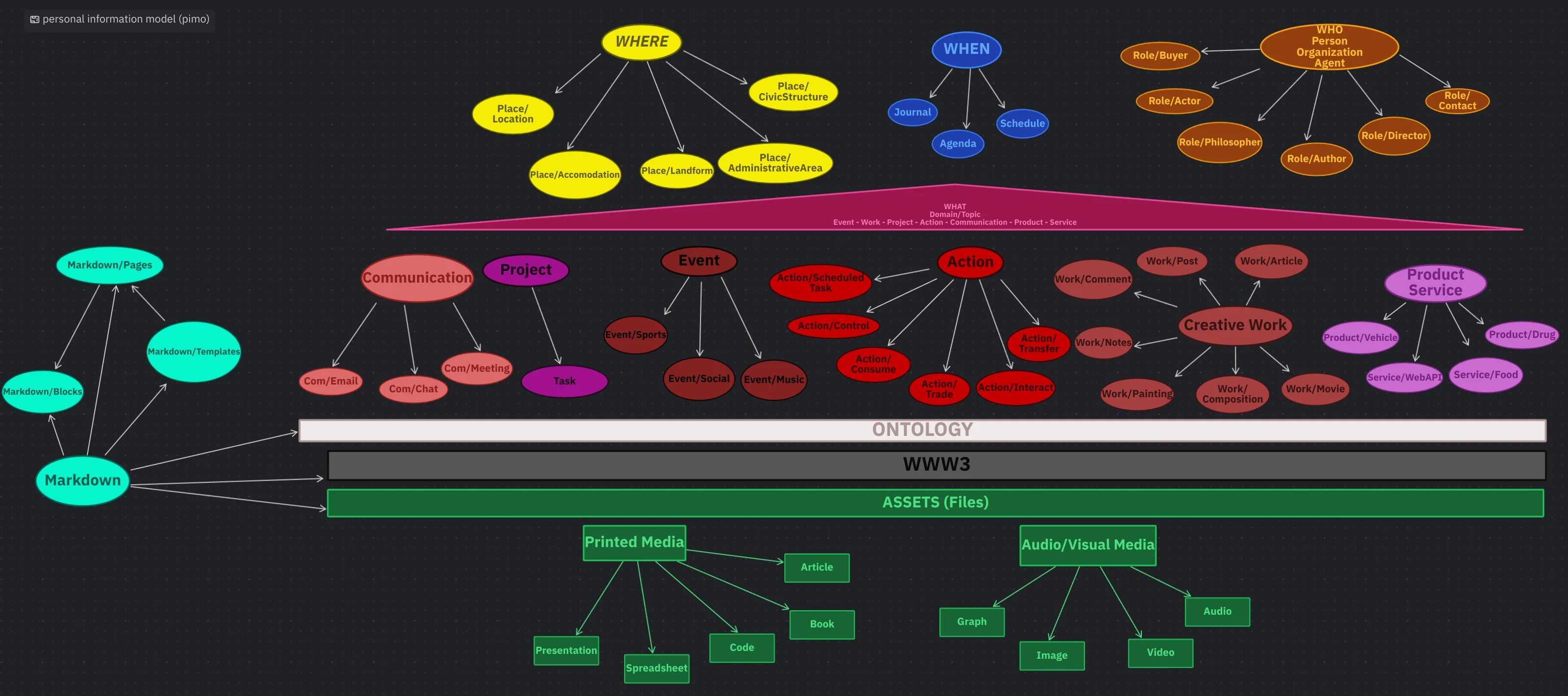
Personal Information Model (PIMO)
The Personal Information Model (PIMO) is an example of a HermesBase application built on the TaxisDB engine.
HermesBase and TaxisBase
TaxisDB is the umbrella project. Today, TaxisBase is TaxisDB’s entire content — the bootstrap ontology, the TBox/ABox architecture, the EAV data model, and the underlying database structures. The TaxisDB / TaxisBase distinction exists for future extensibility: as TaxisDB grows, other components (e.g. a query layer) could join TaxisBase under the same umbrella without requiring a rename or a break in identity.
HermesBase is the project under which the TaxisDB engine is put into practice. It defines the aims, requirements, and architectural principles for using TaxisDB-based ontologies to build decentralized, collaborative management information systems and knowledge bases, spanning Graph Databases, Knowledge Graphs, Personal Information Management, and Enterprise Data Management.
Where TaxisBase answers “how does TaxisDB represent and store knowledge?”, HermesBase answers “how do communities of users organize, govern, and share that knowledge using TaxisDB, and what does an implementation need to guarantee — offline use, P2P interlinking, data ownership, interoperability — for that to work at scale?”
In short:
TaxisDB— the umbrella project, currently synonymous withTaxisBase, reserved for future components.TaxisBase— the ontology and data model that today constitutes the entirety ofTaxisDB: the bootstrap ontology, TBox/ABox structure, EAV model, and database structures.HermesBase— the project that putsTaxisDBinto practice: the standard, the decentralized community, and the architectural principles (reuse, scalability, performance, usability, data fidelity, implementability) governing howTaxisDB-powered applications are built and used.